Please Choose Your Language
close
Choose Your Site
Global
Social Media


| Quantity: | |
|---|---|
| PDF Export | |


K063-1 Series
SiRON
9031809090
About selection
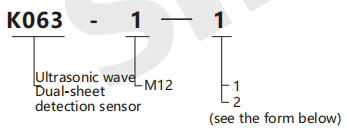
Selection example: K063-1-1 is represented as an M12 ultrasonic dual-sheet detection sensor, with a detection distance of 30 to 60mm and NPN output.
| Seral Number | Detection distance | Output method | SerialNumber | Detection distance | Output method |
| 1 | 30~60mm | NPN | 2 | 30~60mm | PNP |
Specifications
| Name | M12Ultrasonic Double-Sheet Inspection Sensor |
| Model number | K063-1 |
Appea rance |  |
| Output method | NPN/PNP |
| Measurement range | 30~60mm(The range of 30 to 40 is ideal) |
| Frequency | 300KHz |
| Type | DOUBLE SHEET CONTROL |
| Productdiameter | φ12 |
| Testing method | continuous detection |
| Type of testing | Paper,plastic sheets,transparent materials,aluminum foil paper,rubber blankets,cardboard,printed circuit boards,etc |
| Material range | <1.5mm |
| Response time | about 15ms |
| Working voltage | 10~30V |
| Shell material | stainless steel |
| Electromagnetic Compatibility | GB/T17626.2-2006/GB/T17626.4-2008 |
| Power consumption | 20ma |
| Protection circuit | Reverse connection protection and instantaneous overvoltage protection |
| Working temperature | -20℃~80℃ |
| Storage temperature | -40℃~80℃ |
| Length of the line | 1.5m |
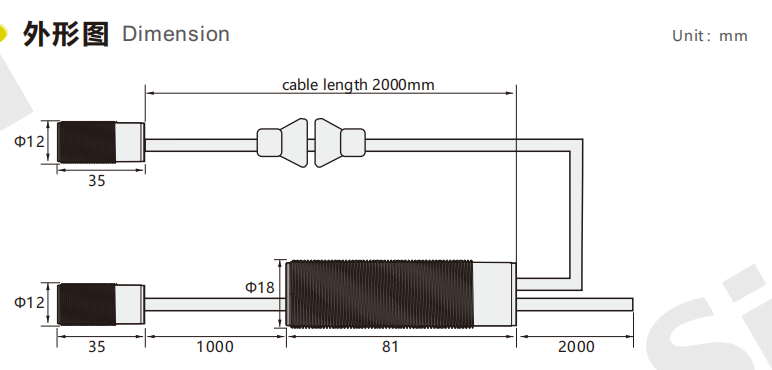
Dimension
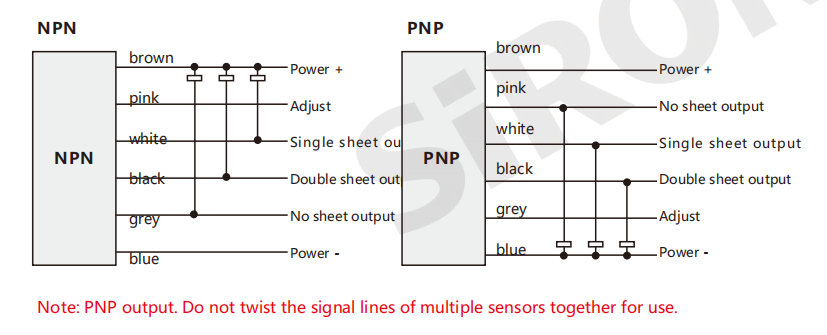
Wiring diagram
Signal lamp
Blue light: No indicator light.
Green light: A single indicator light, with green flashing indicating the set status or the Angle search status.
Red light: Dual indicator lights. A slow flashing red light indicates a setting failure.
Working principle
An ultra-high frequency ultrasonic transmitter emits ultrasonic beams from beneath the thin sheet. Sound waves cause the thin sheet to vibrate, and this also generates a very small beam of sound waves on the other side of the sheet, which is received by the ultrasonic receiver.When the signal passes through two thin sheets (double sheets), it becomes very weak and cannot reach the receiver. By taking advantage of this characteristic, we can detect itNo sheet, single sheet and double sheet.The ultrasonic double-sheet detector is the latest double-sheet detection technology following the photoelectric double-sheet detection. Compared with traditional photoelectric and mechanical detection methods, it has the characteristics of non-contact and wear-free detection. It has no relation to the thickness or color of the paper during detection. Therefore, the ultrasonic double-sheet detection technology is advanced, accurate in operation, simple to operate and extremely convenient to use. It is now widely used in printing machines, laminating machines, collating machines, digital printing machines, material wrapping machines, box gluing machines and other equipment
Set the working state of the sensor
1. Place a single sheet of the material to be tested between the two sensors in its working state. 2. Connect the regulating wire to -UB (power negative). 3. Power on. First, the blue light will flash, then the green light will flash. After the learning is successful, the green light w ill remain on constantly (and enter the normal working mode after learning. At this time, no, single, and double tests can be placed). If it fails, the red light will flash slowly. Please readjust the installation Angle until the learning is completed. 4. Cut off the power and leave the adjusting wire suspended.5. Normal use. If the customer's installation environment is f ixed, you can contact us to solidify the program and avoid setting operations.
Note: After completing the study, please pay attention to the above matters
1: The installation position and Angle of the sensor must not be changed at will.
2: Do not change or replace the material or thickness of the object being tested at will.
Sensor installation
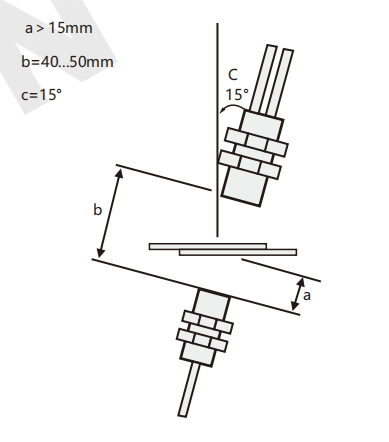
● Adjust the mounting spacing of sensors to approx. 40?50?mm, as shown in Figure b.
● The distance between the sensor end?face and the target object shall be greater than 15?mm, as shown in Figure a.
● Adjust the angle between the sensor and the central axis to 15°, as shown in Figure c.
● If sensors are to be installed side?by?side, keep the mounting spacing at around 10?cm.