
Please Choose Your Language
close
Choose Your Site
Global
Social Media
Views: 0 Author: Site Editor Publish Time: 2026-10-20 Origin: Site


Did you know a single network failure can trigger severe traffic gridlock? Commercial networking gear inevitably fails when exposed to harsh outdoor transportation environments. They simply lack the engineering to handle extreme heat, freezing conditions, or the relentless vibrations of passing vehicles. In this post, you will learn how to choose the right Industrial Switch for your infrastructure projects.
As urban centers evolve into smart cities, the intelligent transportation sector is experiencing a massive technological shift. Based on recent field deployments and industry shifts, transit authorities are rapidly abandoning legacy copper infrastructure. We are seeing a surging demand for edge computing and high-capacity networks. This shift is driven entirely by the integration of AI-powered traffic analytics, automated license plate recognition, and roadside LiDAR sensors. To support this exponential growth in roadside data, municipal engineers are prioritizing hardened networking solutions with robust Power over Ethernet capabilities and multi-gigabit fiber uplinks.
Built for Harsh Environments: Industrial networking hardware operates flawlessly in extreme temperatures from minus 40 to 75 degrees Celsius while resisting shock and moisture.
Industry-Specific Certifications: Transportation applications require strict compliance with regulatory standards like NEMA TS2 for traffic control and EN50155 for railway systems.
Power over Ethernet Capabilities: Delivering power and data over a single cable is essential for remote IP cameras and sensors. It completely eliminates expensive electrical contracting.
Network Reliability: Advanced protocols ensure sub-millisecond network recovery. This keeps critical traffic data flowing without interruption even if a fiber link breaks.
Actionable Deployment: Your choice depends entirely on project scale. Unmanaged hardware is ideal for simple edge connections, whereas managed hardware is necessary for complex network topologies.
Intelligent transportation systems form the critical communication backbone of modern urban infrastructure. Field engineers and procurement officers must fully grasp the physical and operational differences between enterprise-grade networking equipment and industrial-grade hardware. This knowledge justifies long-term infrastructure investments and prevents catastrophic network downtime.
Commercial switches belong in air-conditioned server rooms. They survive in a narrow 0 to 40 degrees Celsius window. Put them in a roadside cabinet, and they will fail. Picture a sealed metal control box baking under the mid-summer Texas sun. Or consider a toll gantry exposed to a brutal Alaskan blizzard. Commercial silicon simply melts or freezes.
To survive these extremes, industrial networking devices utilize advanced fanless cooling architectures. Mechanical fans inevitably draw in conductive dust and eventually die. Instead, ruggedized devices feature extruded aluminum housings. This thick shell acts as a massive heat sink for passive thermal dissipation. Hardware designed for the edge maintains a wide operating temperature range strictly rated from minus 40 to 75 degrees Celsius. This ensures zero thermal throttling during peak summer months.
Transportation environments are inherently violent. Devices deployed near railway tracks or busy highway intersections endure constant physical stress. The relentless rumble of a freight train or a fleet of heavy trucks will quickly cause commercial plastic housings to crack. Internal components will simply vibrate loose.
Industrial models combat this with ruggedized metal enclosures. They typically carry an IP30, IP40, or higher rating. These Ingress Protection ratings guarantee that internal circuitry remains shielded from airborne debris and metallic dust. Furthermore, they undergo rigorous international shock and vibration testing to guarantee physical integrity over a decade of deployment.
Maintenance in remote or highly trafficked locations is exceptionally costly and dangerous. Dispatching a technician to replace a failed switch on a highway toll gantry requires lane closures, bucket trucks, and significant labor expenses. High-reliability components are non-negotiable. Built with industrial-grade silicon and capacitors, these robust devices boast a significantly higher lifespan often exceeding 500,000 hours. This exceptional longevity drastically reduces the total cost of ownership for transit authorities.
Feature | Commercial Switch | Industrial Switch |
|---|---|---|
Operating Temperature | 0 to 40 Degrees Celsius | Minus 40 to 75 Degrees Celsius |
Cooling Mechanism | Mechanical Fans | Fanless Passive Heat Sink |
Enclosure Material | Plastic or Thin Sheet Metal | Ruggedized Aluminum or Steel |
Vibration Resistance | Low | High IEC Compliant |
Power Input | Single AC Adapter | Dual Redundant DC Inputs |
Selecting the correct hardware requires a methodical evaluation of technical specifications. Below is a structured engineering checklist to help buyers compare different models based on real-world field requirements.
Power over Ethernet revolutionizes field deployments. It delivers both data communication and electrical power over a single standard Ethernet cable like Cat5e or Cat6. This elegant solution eliminates the need to run high-voltage electrical lines to every single traffic camera or radar sensor. You save thousands of dollars in electrical contracting costs.
When evaluating power capabilities, field engineers must accurately calculate the total power budget. Standard PoE provides up to 15.4 watts per port. This handles basic environmental sensors. However, PoE Plus delivers up to 30 watts per port. You absolutely need this higher output for Pan-Tilt-Zoom IP cameras equipped with built-in heaters and infrared illuminators.
Bandwidth requirements in modern transportation systems are growing exponentially. While 100Mbps ports are perfectly adequate for transmitting low-bandwidth telemetry data from loop detectors, high-definition video surveillance demands significantly more throughput.
Specifically, if your project involves aggregating live feeds from multiple 4K traffic cameras, Gigabit uplink ports are highly recommended to prevent video latency and dropped frames. Additionally, Small Form-factor Pluggable slots are mandatory for fiber optic uplinks. Copper Ethernet is limited to 100 meters. Fiber optic cables can transmit data over tens of kilometers along highways without signal degradation.
A single point of failure can completely blind a traffic management center. To mitigate this risk, industrial networks utilize resilient topologies like Ring or Daisy Chain configurations.
Standard Spanning Tree Protocol takes several seconds to recover from a broken link. That delay is unacceptable for real-time traffic control. Buyers must look for hardware supporting advanced rapid recovery protocols like Ethernet Ring Protection Switching. This guarantees network recovery times of less than 20 milliseconds if a fiber link is accidentally severed by construction equipment. Your critical data continues flowing seamlessly.
Regulatory compliance is a non-negotiable aspect of municipal procurement. Different transit sectors have distinct environmental and electromagnetic requirements. Ensuring the hardware meets these specific standards mitigates liability and guarantees long-term operational stability.
For smart intersections and roadside control cabinets in North America, NEMA TS2 is the definitive standard. Equipment certified under NEMA TS2 has been rigorously tested to operate continuously in environments with extreme temperature fluctuations, high humidity levels, and severe mechanical vibration. Specifying this compliance ensures the hardware will not fail during a summer heatwave or a winter blizzard.
Railway networks present unique challenges. They generate massive electromagnetic interference and extreme physical shock.
EN50155: This is the primary international standard for electronic equipment used onboard passenger trains and freight locomotives. It mandates strict parameters for temperature, humidity, shock, and vibration. It often requires specialized threaded connectors to prevent cables from vibrating loose during transit.
EN50121-4: Applying to trackside deployments, this standard focuses heavily on electromagnetic compatibility. It ensures the switch can withstand massive electromagnetic surges generated by overhead railway power lines.
One of the most common decisions procurement teams face is choosing between managed and unmanaged hardware. This decision should be dictated by the specific application, network complexity, and available IT resources.
Unmanaged networking devices are built for plug-and-play simplicity. They require no configuration, no IP address setup, and no specialized IT knowledge. Field technicians simply mount them, plug in the cables, and walk away. They are the ideal choice for edge applications where cost-efficiency is paramount.
Connecting a few vehicle detection sensors at an isolated rural intersection does not require complex routing protocols. For projects requiring dependable localized connectivity, an 8-port Unmanaged 100Mbps Industrial Switch serves as an excellent benchmark. It provides the rugged reliability necessary for outdoor deployment without the redundant cost of advanced software features.
Managed devices provide comprehensive control over network traffic. They are strictly required for core networks or complex topologies. Key features include prioritizing critical data over less important background data. They also allow network segmentation to keep public Wi-Fi traffic isolated from critical control data. Furthermore, centralized IT teams can monitor device health and bandwidth usage remotely, drastically reducing troubleshooting time.
Physical installation constraints in roadside environments are often severe. Roadside enclosures have limited real estate. Power availability can also fluctuate wildly.
The vast majority of traffic control cabinets utilize DIN-rail mounting systems. DIN-rail industrial devices are highly compact. They snap securely onto a standard 35-millimeter metal rail. This modular design maximizes the limited vertical space inside NEMA enclosures. It leaves ample room for power supplies and surge protectors. In contrast, large rack-mountable devices are typically reserved for the central traffic management center.
Unlike enterprise hardware that plugs into a standard AC wall outlet, industrial devices rely on DC power. To prevent network failure if a primary power source drops, these devices feature dual redundant DC power inputs. You can wire the device to two separate power supplies. If the primary supply fails, the hardware instantly draws from the backup without dropping a single packet of data.
Intelligent transportation systems represent a diverse ecosystem of interconnected devices. Each sub-sector presents unique environmental challenges and data transmission requirements. Understanding these demands is crucial for selecting the appropriate networking hardware.
Modern smart intersections utilize a combination of IP cameras, radar sensors, and automated traffic signal controllers to optimize flow and reduce congestion. These components are housed in roadside cabinets that lack climate control. During summer months, internal cabinet temperatures easily exceed 60 degrees Celsius. An industrial switch deployed within these cabinets reliably aggregates data from local sensors and transmits it back to a central hub.
Electronic toll collection requires absolute precision and zero network downtime. When a vehicle passes through a toll gantry at highway speeds, high-definition license plate cameras and laser profiling sensors must capture and transmit data in milliseconds. A dropped data packet translates directly to billing errors and lost revenue. High power budgets are also necessary here to drive infrared illuminators for nighttime image capture.
Highway surveillance systems cover vast geographical areas. They require long-distance data transmission that far exceeds the limits of standard copper cables. These environments are characterized by high concentrations of automotive exhaust dust and moisture. Network switches in these deployments utilize fiber optic uplinks to transmit data over several kilometers. The physical enclosures must carry high IP ratings to prevent conductive dust from short-circuiting internal components.
Procuring the correct hardware requires a systematic approach. You must balance performance requirements, environmental constraints, and budgetary limits. Use this practical framework to guide your purchasing decision.
First, map out your network topology and calculate the total throughput required by edge devices. A cluster of simple loop detectors generates minimal data, making a 100Mbps switch highly efficient. Conversely, aggregating multiple high-definition IP cameras requires Gigabit ports to prevent frame loss.
Next, calculate your total power budget. Sum the maximum wattage requirements of every connected peripheral. Always add a 20 percent buffer for safety and future expansion to ensure the chosen hardware will not overload.
Finally, verify the dimensions of your roadside enclosures. Ensure the device supports DIN-rail mounting to save space. Confirm it accepts the specific DC voltage available in your control cabinets.
Bridging the gap between technical requirements and practical deployment requires selecting hardware engineered specifically for the edge of the network. While core infrastructure relies on highly complex routing equipment, most roadside deployments demand reliable continuous edge connectivity. You do not need the overhead of complex software configurations everywhere.
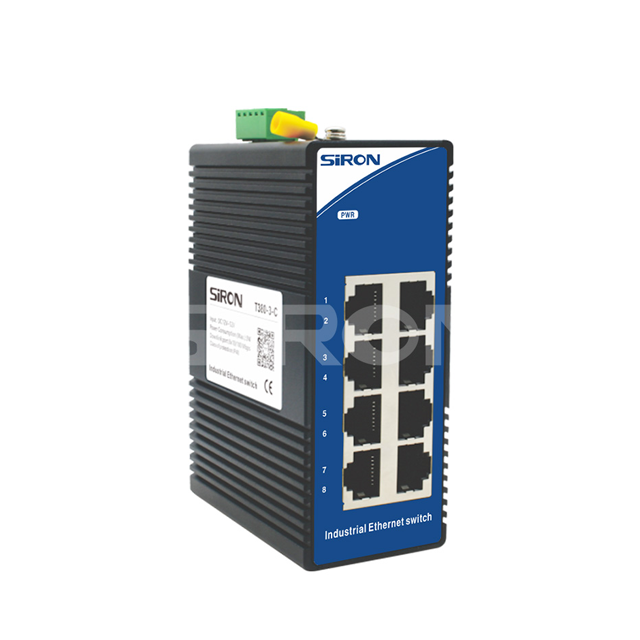
For highly reliable edge connectivity, the SiRON T380 8-port Unmanaged 100Mbps Industrial Switch serves as a prime example of purpose-built hardware. Designed for localized sensor networks, toll booth lanes, and basic intersection control, this unmanaged hardware provides a robust physical foundation.
By offering eight Fast Ethernet ports, it efficiently aggregates data from standard-definition cameras and traffic controllers. The unmanaged nature ensures rapid deployment. Standard industrial features ensure the hardware operates continuously. It boasts redundant dual DC power inputs, an IP40-rated metal enclosure, and standard DIN-rail mounting. It is strictly rated to operate from minus 40 to 75 degrees Celsius.
Intelligent transportation systems depend entirely on the reliability of their communication networks. Commercial hardware will inevitably fail when subjected to the harsh realities of outdoor conditions. This leads to costly downtime and potential safety hazards.
By investing in purpose-built hardware equipped with proper temperature ratings and robust power capabilities, transit authorities can significantly lower maintenance expenses. Are you ready to upgrade your municipal network infrastructure? Evaluate your cabinet space, calculate your power budget, and choose equipment built to last. For rugged, field-tested connectivity, explore professional industrial networking solutions designed to keep your traffic data flowing 24/7.
No. Roadside cabinets experience extreme temperature fluctuations, high humidity, and persistent dust ingress. Standard commercial switches are designed for climate-controlled office environments. If deployed outdoors, their internal fans will clog with dust, and their commercial-grade silicon will quickly overheat in the summer or freeze in the winter. This leads to catastrophic network failure. Always specify hardened industrial hardware for outdoor deployment.
The differences lie entirely in physical engineering and component quality. Industrial switches feature fanless cooling architectures that dissipate heat through corrugated metal enclosures. They utilize industrial-grade internal components capable of operating between minus 40 and 75 degrees Celsius. Additionally, they feature dual redundant power supply inputs, high Ingress Protection ratings against dust and water, and heavy shielding to resist electromagnetic interference.
The bandwidth requirement depends entirely on the camera resolution and the compression standard used. If you are operating multiple high-definition IP cameras or multi-sensor panoramic cameras, a Gigabit switch is highly recommended to prevent video latency and packet loss. However, for standard-definition cameras, license plate readers, or simple environmental sensors, a 100Mbps Fast Ethernet switch is technically sufficient and highly cost-effective.
EN50155 is a rigorous international standard that governs electronic equipment used on passenger trains, trams, and freight locomotives. Compliance indicates that the hardware has passed specific testing for extreme vibration, mechanical shock, temperature variations, and electromagnetic compatibility. Hardware lacking this certification is highly likely to suffer physical connection failures when subjected to the constant motion of railway environments.
Power over Ethernet technology allows a network switch to transmit both digital data and electrical power over a single standard Ethernet cable. This eliminates the significant expense and logistical complexity of hiring certified electricians to install separate power outlets at remote locations. It allows engineers to quickly and safely deploy edge devices like IP cameras and wireless access points anywhere along a highway or intersection.
For highway deployments spanning several kilometers, single-mode fiber optic cable is the industry standard. Unlike multi-mode fiber which is typically limited to a few hundred meters, single-mode fiber can transmit data over tens of kilometers without signal degradation. You will need to ensure your industrial networking hardware is equipped with compatible Small Form-factor Pluggable slots to accept single-mode fiber transceivers.
To calculate your power budget, list the maximum power draw in watts for every device you plan to connect. For example, a basic fixed IP camera might draw 7 watts, while a motorized Pan-Tilt-Zoom camera with built-in heaters might draw 30 watts. Sum these values together. Finally, add a 20 percent safety margin to account for power spikes during device boot-up or extreme cold weather when camera heaters activate.


