
Please Choose Your Language
close
Choose Your Site
Global
Social Media
Views: 0 Author: Site Editor Publish Time: 2026-10-20 Origin: Site


Do high-frequency devices constantly disrupt your control systems? Electrical noise causes major equipment failures on factory floors every single day. I see it constantly in the field. Standard connectors simply cannot block this harmful interference. They leave your network highly vulnerable to data loss and hardware degradation. You need a specialized solution for clean power delivery.
This guide breaks down exactly how filtered connectivity protects your most sensitive frequency components from catastrophic signal interference. We will look at practical engineering solutions to ensure your operations remain stable, profitable, and fully compliant with grid standards.
The Interference Challenge: High-frequency components inherently generate electrical noise. Left unmanaged, this interference completely compromises industrial control systems and communication networks.
An Effective Solution: A hybrid component combining a secure electrical connection with built-in noise suppression optimizes valuable DIN-rail and circuit board real estate.
Cost and Space Efficiency: Integrating the filtering mechanism directly into the connection point frequently eliminates the need for bulky standalone inline filters.
Enhanced Reliability: Filtered connectors ensure clean power delivery. They maintain strict signal integrity and extend the operational lifespan of sensitive frequency devices.
Smart Purchasing: Selecting the right component requires a methodical evaluation of voltage ratings, current capacities, capacitance values, and enclosure mounting styles.
Frequency components encompass a broad spectrum of electrical devices designed to operate at high frequencies or utilize rapid switching mechanisms. Common examples include Variable Frequency Drives, servo motor controllers, power inverters, and radio-frequency transmitters. These devices are the absolute foundation of modern industrial automation. They allow for precise motor control and rapid data transmission across vast facility networks.
However, the very nature of high-frequency circuits makes them uniquely vulnerable to power fluctuations. When devices operate at these elevated frequencies, they are subjected to aggressive voltage changes and rapid current shifts. Imagine a heavy-duty 50HP factory water pump motor spinning up. The resulting voltage transitions can instantly generate significant electrical noise. This noise travels backward through power lines and bleeds into nearby control cables.
Standard terminal blocks are designed purely for mechanical clamping and electrical continuity. They provide a physical bridge for stripped wires but offer zero impedance to high-frequency transients. Without proper shielding, traditional non-filtered blocks can inadvertently act as miniature antennas. They radiate noise into the surrounding environment. Modern control systems require connectivity that acts as an active first line of defense. You need a component that chokes out unwanted frequencies before they can penetrate the core circuitry.
To grasp why specialized connectivity is mandatory, we must examine the mechanics of Electromagnetic Interference and Radio Frequency Interference. Electromagnetic Interference refers to any unwanted electromagnetic emissions that disrupt the normal operation of electronics. Radio Frequency Interference is a specific subset occurring within the radio frequency spectrum.
Frequency components generate this disruptive noise primarily through their rapid switching speeds. Motor drives utilize Pulse Width Modulation to dictate the speed of AC motors. The insulated-gate bipolar transistors inside these drives switch on and off thousands of times per second. This aggressive switching creates parasitic capacitance and severe harmonic distortion. It forcefully pushes high-frequency noise back into the main power supply.
The real-world commercial impacts of unfiltered electrical noise are severe and highly measurable on the factory floor:
Nuisance Tripping and Data Loss: High-frequency spikes easily corrupt communication packets in Programmable Logic Controllers. This leads to sudden, unexplained operational halts and expensive downtime.
False Triggering: Proximity sensors and optical encoders may misinterpret noise spikes as legitimate physical inputs. This causes erratic and dangerous machine behavior.
Thermal Stress: Unfiltered harmonic currents force power supplies and motors to run hotter. This ultimately leads to premature component burnout and high replacement costs.
Beyond equipment failure, regulatory compliance is a strict legal consideration. Unmitigated interference can cause a newly designed machine to fail rigid electromagnetic compatibility standards. Addressing this noise at the exact point of wire termination is a highly effective, space-saving mitigation strategy.
A terminal block featuring an integrated filter is a highly specialized hybrid component. It seamlessly provides the robust mechanical wire clamping expected of a standard industrial block. At the same time, it houses a passive electronic filtering circuit inside the flame-retardant plastic casing. This internal circuit typically consists of precise capacitors, inductors, or a combination of both. It is engineered specifically to suppress incoming and outgoing electromagnetic noise.
The integrated filter operates primarily on the principle of low-pass filtering. When engineers specify a Terminal Block with Filter, they are effectively deploying a low-pass barrier. This barrier allows standard 50/60Hz AC power or DC control signals to flow with zero resistance. Simultaneously, it aggressively chokes out high-frequency transients. The internal capacitors shunt this high-frequency noise safely to the earth ground, diverting it far away from sensitive microprocessors.
Feature |
Standard Terminal Block |
Filtered Terminal Block |
|---|---|---|
EMI/RFI Suppression |
None. Acts as a pass-through. |
High. Blocks high-frequency transients. |
Panel Space Required |
High if paired with a separate filter. |
Minimal. All-in-one compact design. |
Installation Labor |
Requires extra wiring to external filters. |
Plug-and-play direct termination. |
Signal Integrity |
Vulnerable to parasitic inductance. |
Excellent. Filters noise at the entry point. |
Transitioning away from standard connectors offers several empirical advantages for both system design and long-term machinery performance.
Space Optimization in Control Panels
Industrial control panels are almost always constrained by strict spatial limitations. Traditionally, technicians had to install a standard block and then wire it to a separate, bulky filter module. Combining these two functions into a single unit drastically reduces the physical footprint on a DIN rail. This allows for much tighter enclosure designs.
Reduced Wiring and Labor Costs
Fewer discrete components naturally translate to less point-to-point wiring. By eliminating the intermediary cables between a standard block and a standalone filter, manufacturers drastically cut down on installation time. Minimizing these connection points also lowers the statistical risk of wiring errors and mechanical vibration failures.
Superior High-Frequency Performance
From a practical engineering perspective, an integrated component often outperforms a standalone filter in specific high-frequency scenarios. Long wires connecting a standard block to a separate filter introduce parasitic inductance. This actively degrades the filter's effectiveness at very high frequencies. Integrating the filter at the exact point of wire termination completely eliminates this parasitic bottleneck.
Selecting the correct filtered terminal block requires a methodical evaluation of electrical thresholds. Specifying the wrong component can lead to inadequate noise suppression or catastrophic electrical failure. You cannot rely on guesswork here.
Electrical Ratings and Capacity
The foundational step is strictly matching the voltage and current ratings of the block to your power supply. For example, industrial applications frequently require components rated for 250V AC and up to 20A. Exceeding the voltage rating risks dielectric breakdown and dangerous arcing across the plastic housing. Under-specifying the current rating will inevitably lead to excessive thermal buildup.
Attenuation Characteristics and Capacitance
Engineers must clearly understand the insertion loss required for their specific system. Insertion loss indicates how efficiently the filter reduces noise at targeted frequency bands. Choosing the correct capacitance value is paramount. Higher capacitance generally targets lower-frequency noise. Lower capacitance values are precision-optimized for shunting very high-frequency radio interference to ground.
Connection Technologies and Materials
The mechanical termination method directly impacts installation speed and vibration resistance. Screw terminals provide incredibly high contact force, making them ideal for heavy-duty power cables. You also need to verify the housing material. Premium components utilize UL94 V-0 flame-retardant plastics to ensure safety during thermal overload events.
Looking at the broader industrial landscape, the trajectory of high-frequency connectivity is heavily leaning toward miniaturization. Smart manufacturing and the Industrial Internet of Things drive control panels to become denser. Real estate on the DIN rail is at an absolute premium right now.
We are seeing a distinct shift away from multi-stage standalone filtering units toward hybrid components. This trend is accelerated by increasingly stringent global electromagnetic compatibility regulations surrounding grid-tie power quality. The rise of renewable energy and electric vehicle charging stations introduces massive amounts of harmonic distortion into local power grids. Facilities can no longer treat noise mitigation as an afterthought. It must be engineered directly into the panel's point of entry to guarantee compliance and protect sensitive digital sensors.
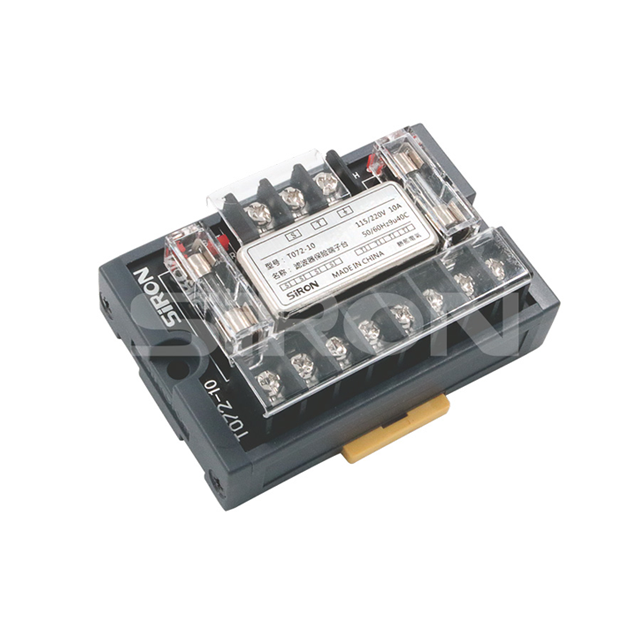
When transitioning from theoretical specifications to practical procurement, evaluating industry-standard components provides highly valuable context. A primary example of an engineered solution for high-demand frequency applications is the SiRON T072 Series.
This specific series is structurally tailored to handle the heavy electrical loads typical of motor drives and power inverters. By incorporating a high-quality integrated filtering circuit, the SiRON T072 Series Power Supply Terminal Block with Filter provides exceptional attenuation capabilities directly at the panel entry point. It features robust screw terminals designed for secure wire retention under heavy industrial vibration.
The housing is constructed from premium flame-retardant materials. Engineers frequently specify this integrated model for automation equipment because it reliably balances rugged mechanical durability with precise, predictable electromagnetic noise suppression. It intercepts high-frequency noise before it has any chance to corrupt the internal logic circuitry.
The necessity of filtered connectivity spans multiple critical industries where frequency components dictate daily operations.
Variable Frequency Drives and Motor Controls
In modern factory automation, motor drives are notorious for generating massive amounts of switching noise. Filtered components are absolutely essential here to protect the low-voltage control logic. They shield 24V DC sensor signals and human-machine interface inputs from the high-voltage harmonic noise violently generated by the drives.
Telecommunications and RF Equipment
Cellular base stations and large-scale radio transmitters rely on absolute signal clarity. In these highly sensitive environments, filtered blocks are deployed on power supply lines. They ensure that external radio interference does not cross-talk into the transmission lines. This maintains a high signal-to-noise ratio and prevents dropped data packets.
Renewable Energy Inverters
Solar and wind power systems utilize heavy-duty inverters to convert generated DC power into grid-compatible AC power. This conversion process relies on rapid transistor switching, generating significant harmonic distortion. Filtered connectivity helps contain this noise locally. It ensures the renewable energy system complies with strict utility grid-tie power quality regulations.
Procuring a high-quality component is only half the solution. Proper installation is critical. Failure to adhere to installation best practices can render even the most advanced filtering circuit completely ineffective.
Proper Grounding Techniques
An integrated filter relies entirely on its ground connection to divert noise safely away from the circuit. If the ground path has high impedance, the noise will simply bypass the filter and continue into the system. Installers must scrape away panel paint to ensure direct metal-to-metal contact. I always recommend utilizing wide braided grounding straps rather than standard round wires. This counteracts the skin effect of high-frequency currents.
Strict Separation of Cables
Even with premium filtered blocks installed, physical cable routing remains a critical aspect of noise management. Engineers must enforce strict physical separation between dirty noisy power cables and clean filtered signal cables. Running a clean cable parallel to a dirty cable will re-introduce interference through magnetic inductive coupling. If they must intersect, they should only cross at sharp 90-degree orthogonal angles.
Adhering to Torque Specifications
When utilizing screw-type components, using a calibrated torque screwdriver ensures optimal mechanical stability and prevents micro-arcing. Under-tightening creates high-resistance joints that generate their own broadband high-frequency noise. Over-tightening can strip the metal threads or physically crush the internal filter capacitors.
System integrity relies entirely on strong, clean connections. As high-frequency devices become faster and more powerful across all industrial sectors, the daily threat of electrical noise will only continue to grow.
Upgrading to a filtered block is no longer an optional luxury. It is a fundamental engineering necessity. These specialized components save premium panel space, drastically reduce installation labor costs, and guarantee reliable operation for your most sensitive equipment. By specifying high-quality solutions, you ensure a noise-free electrical environment that protects your entire control system from the ground up.
If you are experiencing unexplained sensor faults, data drops, or are designing a new high-density control panel, it is time to upgrade your connection points. Explore the specialized filtered connectivity solutions available at SiRON to find the exact voltage, current, and attenuation specifications required to keep your factory floor running flawlessly.
A standard terminal block is a passive mechanical component that simply provides a secure electrical connection between wires. It offers zero protection against electrical noise. Conversely, a filtered block includes integrated electronic components housed within the same physical plastic block. This active circuit is specifically designed to block high-frequency electromagnetic noise while allowing desired low-frequency power or data signals to pass through unimpeded.
In many practical applications, yes. For low to medium-power control circuits, an integrated block provides sufficient decibel attenuation to meet strict compatibility requirements. By replacing a standard block and a bulky standalone filter with a single hybrid unit, engineers save significant space on the DIN rail. However, extremely high-power applications or environments with exceptionally severe noise profiles may still require multi-stage standalone filters in addition to filtered point-of-entry connectivity.
Frequency components operate using rapid switching technologies. They aggressively turn high-voltage power on and off thousands of times per second to control motor speed or convert power formats. This aggressive switching naturally generates high-frequency voltage spikes and harmonic noise. Because these devices also rely on highly sensitive microprocessors to control this switching, the very noise they generate can travel backward through the power lines and corrupt their own logic boards.
The required capacitance value is entirely dependent on the specific frequency of the noise you are attempting to block. As a general engineering principle, higher capacitance values are better suited for filtering out lower-frequency electrical noise. Lower capacitance values are optimized for blocking very high-frequency radio interference. To determine the exact specification needed, you must consult your equipment's regulatory requirements and ideally perform a spectrum analysis of the noise present in your specific facility.
Not at all. From a mechanical standpoint, they are designed to be direct drop-in replacements for standard blocks. They utilize the exact same mounting methods and feature the same standard wiring terminations. The only critical additional step required during installation is ensuring the block has a solid, exceptionally low-impedance connection to the earth ground. Without a proper clean ground, the internal filter cannot safely shunt the interference away from the circuit.
Cable length plays a massive role in high-frequency environments. Long unshielded cables act as antennas, picking up ambient noise after the power has already passed through the filter. To maximize the effectiveness of a filtered terminal block, it must be installed as close to the sensitive equipment or the panel entry point as physically possible. Keeping the filtered lines short prevents re-contamination of the clean power.
Yes, but you must verify the specific component's datasheet. Many filtered terminal blocks are engineered to handle both AC mains power and DC control voltages. The internal passive components, like capacitors and inductors, will pass both 50/60Hz AC and steady DC without issue while blocking high-frequency noise. Always ensure the maximum voltage rating of the block exceeds your circuit's peak operating voltage.


