
Please Choose Your Language
close
Choose Your Site
Global
Social Media
Views: 0 Author: Site Editor Publish Time: 2026-06-14 Origin: Site


Modern engineering demands a delicate balance. You must protect operators, ensure fast machine access, and maintain strict regulatory compliance. You must achieve these goals without causing unnecessary production downtime. A simple magnetic sensor is no longer enough for high-inertia machinery. Today, an active safety door switch serves as the critical defense line in modern machine guarding. These robust systems move beyond basic proximity sensing. They use active electromagnetic locking mechanisms. We design them specifically to secure dangerous areas effectively.
This article provides a comprehensive technical evaluation framework. We will help you select, specify, and implement electromagnetic interlocks correctly. You will learn how to meet current safety directives and evaluate different locking mechanisms. We will explore the vital differences between personnel and process protection. Ultimately, this guide will help you keep your factory floor secure while maintaining optimal operational efficiency.
Process vs. Personnel Protection: The choice between power-to-lock and power-to-unlock electromagnetic switches depends entirely on whether you are protecting the machine process or human life.
Compliance is Non-Negotiable: Modern guard door interlock selection must align with ISO 14119, specifically addressing defeat resistance and coding levels.
Integration Realities: Advanced electromagnetic safety switches utilize RFID and OSSD outputs to prevent fault masking, a common failure point in traditional series-wired mechanical switches.
Holding Force Matters: Specifying the correct holding force (Fzh) requires calculating physical impacts, door weight, and environmental vibration.
Understanding when to use a locking switch instead of a basic sensor is critical. The decision hinges entirely on the concept of machine run-down time. Certain industrial machines carry immense kinetic energy. Think of a high-speed centrifuge, a heavy stamping press, or a large industrial mixer. When you cut the power, these machines do not stop instantly. Their rotating masses continue to move.
Safety engineers calculate a specific baseline requirement. You must compare the machine's stopping time to the operator's approach time. If a machine takes ten seconds to stop, but an operator can reach the hazard in two seconds, a simple industrial door monitoring switch is insufficient. It will shut off the power, but it cannot prevent the operator from opening the door and touching moving parts. In this scenario, physical guard locking becomes absolutely mandatory. The door must remain locked until the hazardous motion ceases completely.
You must align your switch selection with standard risk assessments. The ISO 12100 standard dictates how we evaluate machinery risks. It forces engineers to systematically identify hazards. A proper risk assessment usually follows a clear sequence:
Identify the hazard zones within the machinery.
Measure the maximum stopping time of all hazardous movements.
Calculate the minimum distance between the guard door and the hazard.
Determine the required performance level (PL) for the safety function.
Choosing an inadequate switch carries severe operational risks. Consider the cost of bypass. Operators often feel pressured to maintain high production rates. If you install a basic magnetic switch, a frustrated operator might bypass it. They can easily tape a spare actuator to the sensor. This simple act tricks the machine into thinking the door is closed. This "cheating" exposes personnel to lethal hazards. It also creates immense legal liability for the facility. Advanced electromagnetic options solve this problem. They physically lock the guard and use complex coding to prevent unauthorized overrides.
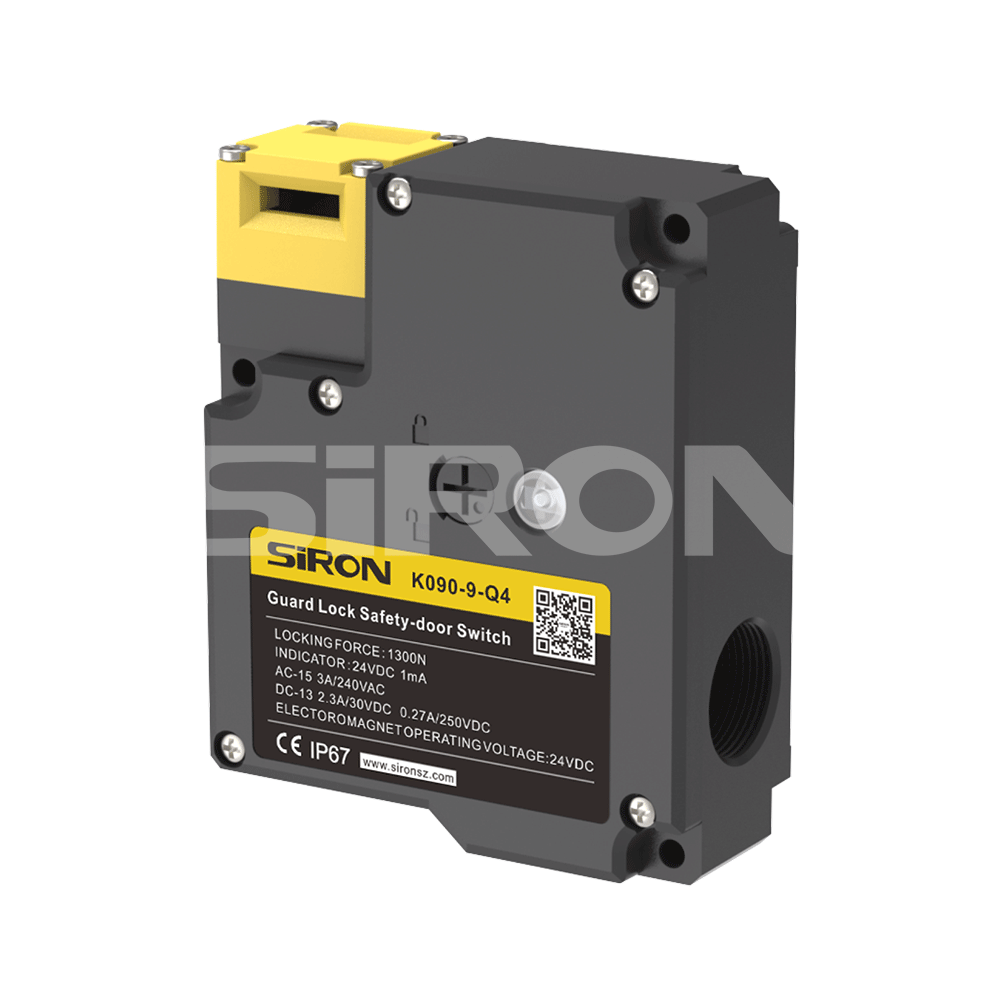
Specifying a machine safety lock requires you to understand actuation principles. You must choose between two fundamentally different locking mechanisms. The wrong choice can lead to catastrophic accidents or ruined production batches. Let us examine the technical differences between power-to-unlock and power-to-lock systems.
The power-to-unlock mechanism defaults to a locked state. It uses a strong internal mechanical spring to hold the locking pin in place. When the machine reaches a safe state, the safety controller sends a voltage signal to an internal solenoid. This electromagnetic force overcomes the spring tension. It withdraws the pin and allows the door to open.
This design is mandatory for personnel safety applications. It provides fail-safe protection. Imagine a total facility power failure. The machine loses power, but the heavy spindle continues to spin due to inertia. The safety switch also loses power. Because it relies on a spring rather than electricity to stay locked, the door remains securely shut. The guard door interlock protects the operator in the dark until the machine naturally spools down.
However, this fail-safe design has minor drawbacks. Because the door locks without power, maintenance crews cannot easily access the machine during a total outage. To solve this, manufacturers integrate auxiliary manual release mechanisms. Engineers use special tools to override the lock during emergencies. You must strictly control access to these override tools.
The power-to-lock mechanism operates in reverse. It uses an active electromagnetic field to hold the locking pin in place. When you remove power, an internal spring immediately retracts the pin. The door unlocks automatically upon power loss.
You must use this mechanism strictly for process protection. We use it to prevent interrupted batches or expensive tool damage. For example, opening a CNC enclosure mid-cycle might ruin a delicate aerospace component. The switch locks the door to keep operators from ruining the work. However, you must never use this for primary personnel safety on high-inertia machines. If the facility loses power, the door unlocks instantly. The operator could open the guard and reach the spinning tool.
We created a simple logical framework for safety specifiers. Use this chart to determine your actuation requirement quickly.
Primary Protection Goal | Hazard Type | Required Actuation Principle | Behavior on Power Loss |
|---|---|---|---|
Personnel Safety | High Inertia (Long run-down time) | Power-to-Unlock | Remains Locked (Fail-Safe) |
Personnel Safety | Low Inertia (Stops instantly) | Non-locking or Power-to-Unlock | Safe to Open |
Process Protection | Product/Tooling Damage Risk | Power-to-Lock | Unlocks Automatically |
Machine safety depends heavily on operator compliance. Unfortunately, industry reality paints a different picture. Operators frequently bypass safety systems. They do this to clear jams faster or perform rapid maintenance. This intentional defeat of protective devices is a major cause of industrial amputations. Standardizing bodies recognized this danger. They updated ISO 14119 to address defeat resistance directly.
The standard categorizes interlocking devices into four types. Traditional mechanical tongue switches fall under Type 2. They are notoriously easy to bypass with a spare metal actuator. Modern systems use advanced technology to eliminate this vulnerability. A modern electromagnetic safety switch usually falls under Type 4. These devices incorporate non-contact Radio Frequency Identification (RFID) technology.
Type 4 switches use highly coded RFID actuators. The safety standard defines "high coding" strictly. A high-coded switch pairs with an actuator that has over 1,000 unique possible codes. In reality, most modern RFID switches have millions of unique combinations. The switch only responds to its uniquely paired counterpart. If an operator tapes a spare actuator to the switch, it will not work. The controller recognizes the foreign RFID signature and keeps the machine in a safe fault state. This technology makes "cheating" virtually impossible.
Safety engineers must prove this defeat resistance to auditors. Compliance verification requires meticulous documentation. You cannot simply buy a high-coded switch and consider the job done. You must install it correctly. Auditors look for specific mechanical mounting methods:
Non-Removable Fasteners: You must install actuators using one-way screws, rivets, or permanent welding. Operators must not be able to unbolt the actuator easily.
Hidden Installation: Whenever possible, mount the switch out of immediate reach or line of sight. If operators cannot easily reach the sensor, they are less likely to tamper with it.
Status Monitoring: Ensure the safety PLC logs any tampering attempts or mismatched RFID codes for maintenance review.
Electrical implementation presents its own set of distinct challenges. Historically, engineers wired dry-contact mechanical switches in series. They did this to save money on safety relay inputs. You would string five doors together on a single electrical channel. If any door opened, the circuit broke, and the machine stopped. However, this traditional wiring method introduces a dangerous phenomenon.
We call this phenomenon "fault masking." It occurs in series-connected, dry-contact systems. Imagine a short circuit happens across the internal contacts of switch number one. The controller cannot see this short. If an operator opens door number one, the machine will not stop. The hazard remains active. If another operator opens door number two, the machine finally stops. However, opening door number two resets the safety relay. It "masks" the deadly short circuit in door number one. The controller falsely reads a safe state. The next time someone opens door one, they could face fatal consequences.
Modern electromagnetic switches eliminate this historical danger entirely. They use Output Signal Switching Device (OSSD) technology. OSSD does not rely on simple mechanical dry contacts. Instead, the switch generates active, pulsed semiconductor outputs. The internal microprocessor monitors these microscopic voltage pulses continuously.
The OSSD advantage is massive. If a short circuit occurs across the wires, the pulse pattern distorts immediately. The microprocessor detects this distortion in milliseconds. It shuts down the safety outputs before a dangerous situation can develop. Furthermore, OSSD allows you to connect multiple doors in series safely. You can cascade these smart switches without degrading the overall safety performance level. You can easily maintain PL e or SIL 3 ratings across long production lines.
Controller integration requires careful planning. You must connect OSSD outputs to compatible safety PLCs or dedicated safety relays. Standard standard PLC inputs cannot read OSSD pulses correctly. They will interpret the microscopic test pulses as flickering signals. When integrating these systems, always review your diagnostic coverage (DC). A high diagnostic coverage ensures the controller catches internal component failures before they compromise the safety function.
Specifying a guard door interlock is not a guessing game. You must evaluate strict mechanical and environmental parameters. The most critical mechanical specification is the holding force. Engineers often confuse two important metrics: F1max and Fzh.
F1max represents the ultimate breaking force. It is the exact amount of physical force required to rip the locked switch apart mechanically in a laboratory test. You must never use F1max as your design target. Instead, you must specify your systems based on the rated safe holding force, known as Fzh. Safety standards dictate that Fzh includes a mandatory safety margin. Manufacturers calculate Fzh by dividing the F1max by a safety factor (typically 1.3). For example, if a heavy industrial door experiences physical impacts from internal robot crashes, you must ensure the Fzh rating exceeds the maximum expected impact force.
Environmental ratings dictate long-term reliability. A switch will fail quickly if it cannot survive its surroundings. You must evaluate ingress protection carefully.
IP67 Environments: These switches handle heavy dust and temporary water immersion. They are perfect for standard dry manufacturing, CNC milling, and general automation.
IP69K Environments: These require extreme protection. We use them in food and beverage packaging or pharmaceutical production. They withstand daily high-pressure, high-temperature chemical washdowns.
You must also assess environmental vibration. Heavy stamping presses and large CNC lathes generate aggressive, continuous shocks. If a mechanical switch vibrates too much, its internal contacts might chatter. This chatter causes nuisance tripping, shutting down the machine randomly. Advanced electromagnetic locks use solid-state sensors. They tolerate immense vibration without dropping the safety signal.
Mechanical misalignment tolerance is another practical reality. Over time, heavy machine doors sag on their hinges. Industrial environments are harsh. Rigid tongue-and-groove mechanical switches jam when doors misalign. Maintenance teams waste hours filing down metal tongues to make them fit. Modern electromagnetic locks solve this elegantly. They utilize floating actuators. These actuators pivot and shift on their mounting brackets. They easily accommodate door sag and horizontal shifting. This design significantly reduces maintenance call-outs compared to older rigid systems.
Specifying an industrial safety door switch is a complex, calculated process. You must balance strict standard compliance with daily operational realities. You cannot ignore ISO 14119 guidelines. You must rigorously evaluate machine run-down times to determine if active locking is mandatory. Furthermore, you must upgrade your wiring architecture to OSSD configurations to eliminate the silent threat of fault masking.
We strongly advise looking beyond the initial unit price when selecting hardware. You must evaluate the practical installation time and the advanced diagnostic capabilities of the device. High-coded RFID models prevent intentional bypasses, saving you from catastrophic liability. A cheaper switch often leads to expensive production downtime due to vibration-induced nuisance tripping or jammed actuators.
Take immediate action to secure your facility. We encourage you to review your current machine risk assessments today. Walk your production floor and inspect your existing interlock configurations. Look for rigid tongue switches that might be easily defeated. If you spot potential vulnerabilities, consult a certified machine safety expert. Upgrading to modern electromagnetic locking technology is the most effective way to protect your operators and your production schedule.
A: A safety monitoring switch only detects the door's position. It signals the machine to stop when opened but does not physically restrict access. A safety locking switch features an active mechanism. It physically holds the door shut and prevents opening until the hazardous machine motion comes to a complete, safe stop.
A: Generally, no. If personnel can access hazardous motion, you cannot use power-to-lock. This mechanism unlocks instantly if the facility loses power. Power-to-lock is strictly for process protection. You must use a fail-safe power-to-unlock switch for personnel safety around dangerous robotics.
A: RFID technology provides "high coding" as defined under the ISO 14119 standard. A high-coded switch pairs with an actuator containing a unique electronic signature. It ignores all other sensors. This makes it virtually impossible for an operator to defeat the interlock using a standard magnet, tape, or a spare key.
A: Fault masking is a critical, dangerous wiring flaw found in series-connected mechanical contacts. If a short circuit occurs in one switch, opening a different door further down the line can reset the safety relay. This causes the controller to falsely read a safe state, hiding the original short circuit.


