
Please Choose Your Language
close
Choose Your Site
Global
Social Media
Views: 0 Author: Site Editor Publish Time: 2026-06-13 Origin: Site


Selecting the wrong protocol at the hardware level creates severe operational bottlenecks. Choosing poorly limits your network topology. It also introduces massive integration headaches when connecting new hardware to existing programmable logic controllers (PLCs). Every millisecond counts in modern manufacturing. You need a reliable physical layer to guarantee machine uptime. Both EtherCAT and PROFINET dominate modern industrial Ethernet today. However, their underlying data-handling mechanisms serve entirely different architectural goals. One prioritizes high-speed, deterministic synchronization for complex robotics. The other focuses on highly flexible IT/OT convergence across large plant floors. This guide provides a pragmatic, evidence-based evaluation framework. We want to help automation engineers match the correct hardware to their specific application requirements. By understanding these core differences, you avoid costly architectural redesigns. Read on to discover which communication standard fits your factory floor best.
EtherCAT excels in high-speed, deterministic motion control, utilizing "on-the-fly" processing for microsecond-level synchronization.
PROFINET offers superior network flexibility and seamless enterprise IT integration, leveraging standard Ethernet switches and robust diagnostics.
Hardware Ecosystems: EtherCAT IO modules heavily favor ring/daisy-chain topologies with centralized logic, whereas PROFINET IO modules support highly decentralized, star-topology distributed IO systems.
Selection Driver: The choice rarely hinges on "which is better," but rather on your primary PLC vendor (e.g., Beckhoff/Omron vs. Siemens) and whether your priority is sub-millisecond jitter or network-wide data accessibility.
An industrial io module acts as the physical bridge connecting field devices to your main controller. It captures analog or digital signals from factory floor sensors and translates them into network data. Your chosen protocol dictates the internal Media Access Control (MAC) layer capabilities. This hardware boundary determines exactly how fast the module processes incoming signals before forwarding them upstream.
Implementing a distributed io system profoundly impacts your physical factory layout. A decentralized approach reduces long cable runs. You can place IO nodes directly next to the machines they control. However, the protocol you select dictates whether these nodes must connect in a strict line or if they can branch out via network switches.
You rely on a fieldbus coupler module to make this decentralized architecture function. This coupler serves as the brain of an IO slice assembly. It receives the high-level industrial Ethernet protocol and translates it into the proprietary backplane bus used by the individual input/output terminals. A bottleneck at the coupler limits the entire station.
To guarantee a successful implementation, system architects must evaluate several physical success criteria. Relying on spec sheets alone often leads to poor field performance. Consider these crucial factors during your planning phase:
Cycle times required for your tightest control loops.
Acceptable jitter limits for mechanical motion precision.
Maximum node count constraints per network segment.
Overall configuration and diagnostic complexity during commissioning.
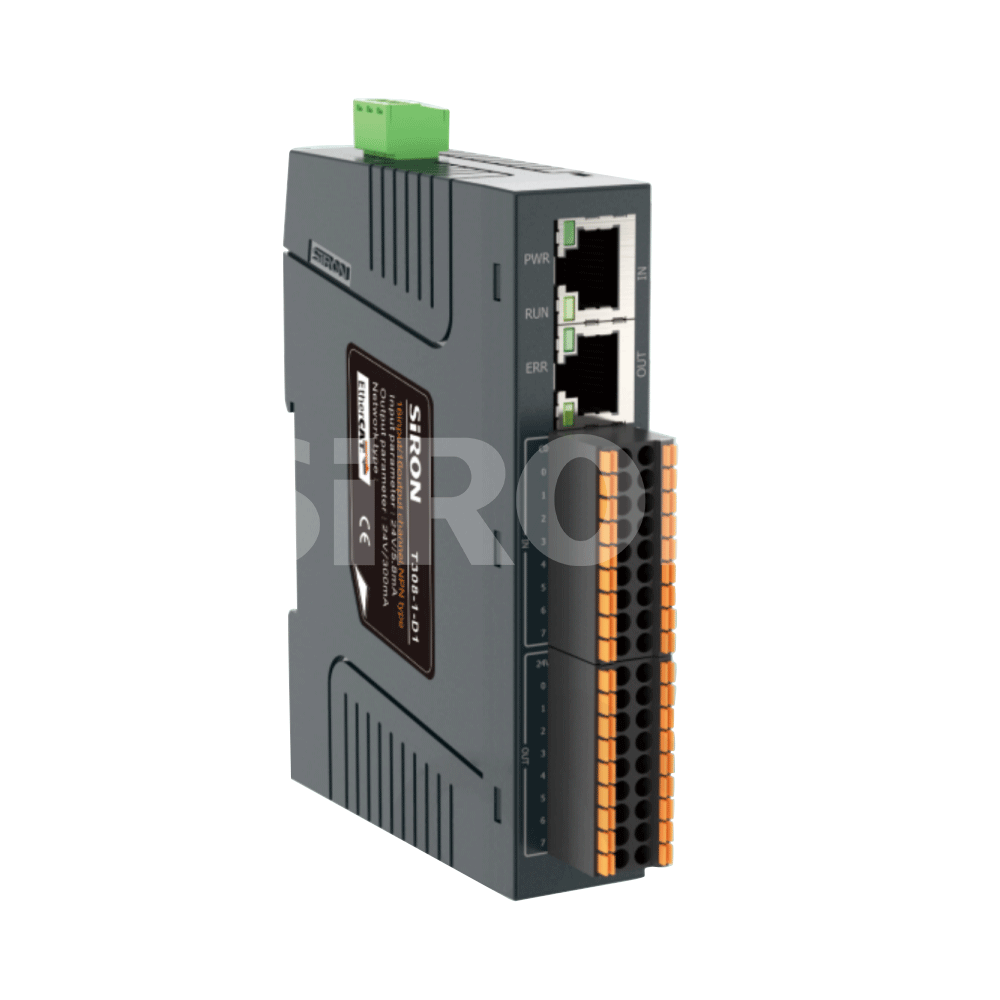
The EtherCAT Technology Group (ETG) defines a unique "on-the-fly" processing mechanism. An ethercat io module reads and writes data as the Ethernet frame passes through its MAC layer. The frame never actually stops inside the node. The specialized hardware extracts designated output data and inserts input data in mere nanoseconds. This eliminates the standard store-and-forward delays seen in traditional networking.
Realistic benchmarks show incredible machine performance. Automation engineers routinely achieve sub-millisecond cycle times. You also see extremely low network jitter, often measuring below one microsecond. This level of precision is highly relevant for computer numerical control (CNC) machines. Multi-axis robotic arms require this exact timing to ensure smooth tool paths and avoid mechanical collisions.
Topology strengths represent another major advantage. Daisy-chaining provides inherent network efficiency. You simply connect one node directly to the next using standard Ethernet cables. You rarely need external managed switches. This simplifies the wiring diagram and reduces potential points of hardware failure inside the control cabinet.
Despite these benefits, you must understand the implementation realities and trade-offs. A common mistake is underestimating the processing power required by the master device. Consider the following challenges:
Strict hardware and processing requirements apply to the master controller, as it handles all centralized logic.
Troubleshooting physical cable breaks becomes highly complex in large ring topologies.
Adding custom IT data packets into the stream requires specialized tunneling protocols.
PROFINET utilizes the standard IEEE 802.3 Ethernet approach for industrial applications. It operates on the same physical infrastructure as standard office networks. The protocol differentiates strictly between PROFINET RT (Real-Time) and IRT (Isochronous Real-Time). RT skips the TCP/IP layers to handle general IO polling quickly. IRT utilizes specialized bandwidth reservation for rigorous motion control tasks.
Enterprise integration remains PROFINET's greatest strength. A profinet io module coexists seamlessly alongside standard TCP/IP traffic on the exact same wire. This makes passing diagnostic data to Supervisory Control and Data Acquisition (SCADA) systems incredibly simple. You can connect your factory floor directly to Enterprise Resource Planning (ERP) databases without complex gateways.
Network topology remains highly flexible. You can build star, tree, and line layouts based on your physical plant constraints. Standard industrial switches route the traffic easily. This flexibility allows engineers to add new machine cells without redesigning the entire factory network.
However, this flexibility introduces its own set of implementation trade-offs. System integrators must plan their network traffic carefully. Keep these limitations in mind:
General RT traffic presents a higher potential for network jitter compared to EtherCAT.
Achieving microsecond motion control requires specialized, costlier IRT-compatible network switches.
Network load management demands careful switch configuration and precise bandwidth calculation.
The fundamental distinction lies in cycle timing. Compare microsecond synchronization against millisecond-level reliable polling. EtherCAT dominates heavy motion control applications. Its on-the-fly processing ensures all servo drives execute commands simultaneously. PROFINET RT handles process automation beautifully. It easily manages thousands of valves, temperature sensors, and flow meters across a massive chemical plant.
System architects frequently discuss integration headaches on engineering forums. Siemens environments naturally dictate a PROFINET approach. TIA Portal integrates PROFINET devices flawlessly. Conversely, Beckhoff and Omron platforms heavily favor EtherCAT natively. You can use third-party gateways to bridge these ecosystems. However, gateways introduce severe latency penalties and complicate your troubleshooting process.
EtherCAT theoretically supports up to 65,535 nodes per segment. This provides massive scalability for complex, highly dense machines. You rarely hit IP address limitations. PROFINET faces subnet constraints based on standard IP addressing rules. You must carefully monitor broadcast traffic and bandwidth considerations across your managed switches as the facility expands.
We must contrast the baseline hardware deployment costs. EtherCAT nodes require specialized Application-Specific Integrated Circuit (ASIC) chips to execute on-the-fly processing. This raises the individual module manufacturing cost. PROFINET nodes use more standard Ethernet controllers. However, PROFINET relies heavily on industrial-grade managed switches to route traffic efficiently. These network switches add significant infrastructure costs to large facility deployments.
Feature Specification | EtherCAT | PROFINET |
|---|---|---|
Processing Mechanism | On-the-fly MAC processing | Standard Ethernet switching (RT/IRT) |
Ideal Topology | Line, Ring, Daisy-chain | Star, Tree, Line |
Hardware Dependency | Specialized ASIC required | Standard controllers, requires switches |
IT/OT Convergence | Requires EoE (Ethernet over EtherCAT) | Native TCP/IP coexistence |
Primary PLC Ecosystem | Beckhoff, Omron | Siemens, Phoenix Contact |
Risk mitigation requires proactive engineering. Configuration hurdles exist for both communication standards. PROFINET uses General Station Description Markup Language (GSDML) files for device integration. EtherCAT relies on EtherCAT Slave Information (ESI) files. Version mismatches in these XML files cause immediate communication failures. Security implications also differ wildly. PROFINET inherently exposes field devices to broader IT networks. You must configure firewalls properly. EtherCAT maintains a highly closed-loop nature, naturally air-gapping the machine from office network threats.
Use this decision tree to finalize your shortlisting logic:
Choose EtherCAT if: Your application relies heavily on servo drives. You need tight multi-axis synchronization for robotics. You want to minimize extra switch hardware inside your control cabinets.
Choose PROFINET if: Your facility runs primarily on a Siemens backbone. You require extensive safety integration using PROFIsafe across widespread areas. You need deep IT network convergence for predictive maintenance data.
Your next steps should involve a thorough system audit. Advise your engineering team to audit the current PLC environment first. Consult hardware vendors for proof-of-concept testing. Always verify actual network loads and cycle times on a physical test bench before finalizing your bill of materials.
Both protocols offer robust, industry-proven hardware solutions. Their architectural philosophies simply cater to different primary needs. EtherCAT delivers raw, deterministic speed through specialized hardware processing. PROFINET delivers massive enterprise integration flexibility using standard networking infrastructure. Standardizing on a protocol should strictly align with your facility's long-term automation roadmap. Do not base this critical decision solely on the baseline specifications of a single machine.
A mismatched protocol inevitably leads to hardware replacements down the line. We encourage you to review specific coupler modules and technical documentation today. Contact your technical sales representatives to request a comprehensive architecture review before finalizing your network layout.
A: Yes, you can mix them using specialized protocol gateways or proxy couplers. However, this translation process introduces inherent network latency. This latency degrades high-speed motion control performance. You should only use mixed networks for non-critical process data sharing.
A: Ease of configuration is highly subjective and depends entirely on your IDE experience. TIA Portal makes PROFINET integration incredibly seamless through automated device detection. Conversely, TwinCAT environments make EtherCAT configuration native and straightforward. Your preferred PLC brand dictates the learning curve.
A: PROFINET IRT achieves comparable microsecond cycle times for strict motion control. However, it relies heavily on hardware-assisted switching and precise bandwidth reservation to achieve this. EtherCAT inherently achieves low jitter through its natural on-the-fly processing mechanism, requiring far less complex switch configuration.
A: Yes, third-party modules perform reliably if they carry official certifications. Look for ETG (EtherCAT Technology Group) or PI (PROFIBUS & PROFINET International) conformance marks. These certifications guarantee strict interoperability, predictable cycle times, and stable communication with your primary controller.


